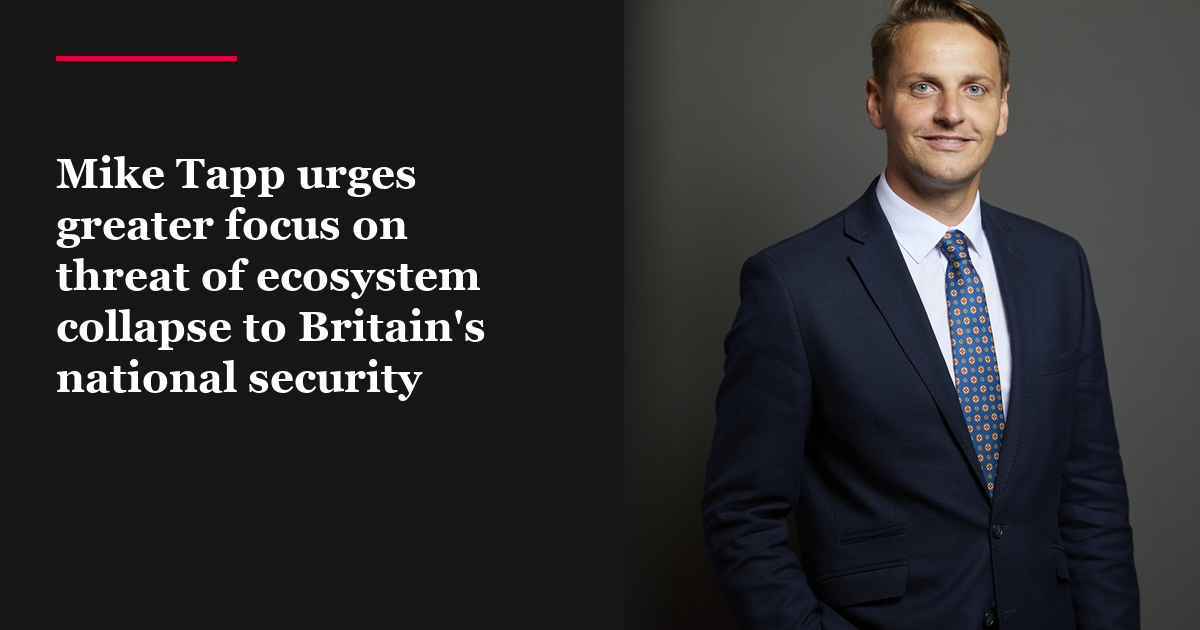
Mike Tapp MP has called for greater public and political attention to a government assessment warning that global biodiversity loss and ecosystem collapse pose serious risks to Britain’s food supply, economy and national security.

The Labour MP for Dover and Deal said the report, published in January, had received too little attention despite its stark conclusions.
Tapp said:
“A UK national security assessment has warned that climate-driven ecosystem collapse could threaten our food security, drive migration, increase geopolitical instability and raise the risk of conflict.
“It was published in January.
“Most people have never heard of it.
“We should be talking about this far more.”
The assessment, produced by the Department for Environment, Food and Rural Affairs with input from experts across government, examines a reasonable worst-case scenario using methods associated with intelligence and national-security analysis. It concludes with high confidence that the degradation and collapse of global ecosystems threaten the UK’s security and prosperity, as reported when the document was published.
The effects are already being experienced through crop failures, increasingly severe natural disasters and outbreaks of infectious diseases. Without substantial intervention, the report judges that these threats are highly likely to grow through to 2050 and beyond.
Cascading risks and tipping points
Its authors warn that the consequences could spread far beyond the natural environment. Food shortages, water insecurity and the loss of livelihoods can contribute to migration, poverty and political instability. Competition between countries and armed groups for increasingly scarce resources could then intensify existing conflicts or create new ones.
The report also highlights the danger of feedback loops in which environmental, economic and security problems reinforce one another. Crop failures can increase food prices, place pressure on household budgets and destabilise vulnerable countries. Political disorder can then undermine the institutions and international cooperation needed to address the original environmental threat.
Six strategically important ecosystem regions are identified as being particularly significant for the UK: the Amazon rainforest, the Congo Basin, South-East Asian coral reefs and mangroves, the Himalayas and the boreal forests of Russia and Canada. These ecosystems influence global food production, rainfall, water supplies, carbon storage, weather patterns and the spread of disease.
The assessment warns that every critical ecosystem it considered is on a pathway towards collapse unless current trends are reversed. There is significant uncertainty about exactly when particular tipping points might be reached. However, the report identifies a realistic possibility that some coral reefs, boreal forests and Himalayan systems could begin collapsing from 2030.
Food security and Britain’s supply chains
The implications for Britain’s food security are especially serious. The UK imports a proportion of both its food and fertiliser. Severe damage to major food-producing regions could reduce crop yields, shrink the amount of arable land, disrupt fisheries and cause greater international competition for remaining supplies.
The assessment concludes that without a substantial improvement in the resilience of British food production and supply chains, the UK could struggle to maintain food security in a world where ecosystem collapse drives competition between states. Domestic farming would also face mounting pressure from depleted soils, declining pollinator populations, droughts and floods.
Tapp’s intervention is particularly timely following catastrophic flooding along the Nepal–China border, where the collapse of a Himalayan glacier triggered widespread destruction and a major humanitarian emergency. While individual extreme events require careful scientific analysis, the disaster illustrates the human and security consequences that can follow when climate change and environmental instability affect fragile mountain ecosystems.
Nature as national security
The Labour government has recognised that protecting nature is essential to Britain’s economic resilience as well as its environmental future. Its Environmental Improvement Plan links nature restoration to growth, food security and public wellbeing, while international commitments include protecting 30 per cent of land and oceans and bringing 30 per cent of degraded nature under restoration by 2030.
However, Tapp argues that the national-security implications require a much wider conversation. Protecting forests, soils, rivers, oceans and wildlife should not be treated as a secondary interest disconnected from everyday life. These natural systems provide the food, water, clean air, medicines and stable climate upon which societies and economies depend.
The assessment makes clear that investment in ecosystem protection, resilient agriculture and secure supply chains should form part of Britain’s national-security planning.
By drawing attention to the report, Tapp is helping move biodiversity loss from the margins of political debate to where the government’s own evidence shows it belongs: alongside the major strategic challenges facing the country.