Andy Burnham's first Labour conference speech as Prime Minister did more than announce a collection of policies. It offered a clear argument about why so many people feel Britain has stopped working for them - and what a Labour government should do about it.
His starting point was that hope requires honesty. Burnham acknowledged that the country's problems did not begin with the last government or the latest political crisis. He connected the loss of industry, the weakening of local government, the sale of essential services and the effects of Brexit to a deeper loss of public control.
That gave the speech a thread running from housing to energy, care and devolution. These were not presented as separate problems to be managed one department at a time. They were the foundations people need to build a decent life and businesses need to grow.
Burnham was at his most persuasive when he brought that argument back to ordinary experience. A secure home can open opportunities across a lifetime. An unaffordable electricity bill can prevent a small business from expanding. A grid connection that never arrives can hold back investment. And a failing care system leaves families, care workers and the NHS carrying costs that politics has avoided confronting for too long.
His proposals followed from that diagnosis: more council housing, stronger powers over poor-quality and empty homes, a route to public ownership for failing water companies, and a publicly owned Great British Grid intended to speed up connections. Whether each delivers will depend on legislation, funding and execution. But together they amount to an identifiable approach to governing.
The most consequential part of the speech was Burnham's case for a National Care Service. He spoke movingly about his family's experience and the people who cared for his father. He also acknowledged the difficult choice behind his proposal to change the pension triple lock after the current Parliament. That decision will be contested, including within Labour. Voters deserve to see the detailed funding and delivery plan as it develops. But there is political courage in explaining a trade-off openly while making the case for a service that could give families greater security in later life.
Burnham applied the same principle to young people. Rather than treating rising welfare spending simply as a reason to withdraw support, he argued for earlier investment in education, mental health, technical routes and work opportunities. It was a reminder that Labour's answer to insecurity should be to expand people's choices.
There was boldness, too, in his willingness to reopen the debate about Britain's relationship with Europe. His assessment that "Brexit has done more harm than good" did not settle which future arrangement the country should choose. It did, however, make room for an honest discussion about growth, trade and cooperation instead of pretending the present position needs no improvement.
The speech's promise will now be judged in homes built, bills reduced, care improved and power genuinely transferred from Whitehall. Those tests should be demanding. Hope is not a substitute for delivery.
But Labour also needs a convincing account of what it is trying to achieve. In Liverpool, Burnham offered one: a country in which working people have more security, communities have more say, and government is willing to tackle problems that have been left unresolved for decades. It was a speech with the confidence to ask Britain to think bigger - and the honesty to admit that doing so will not be easy.
Read Andy Burnham's full conference speech here.
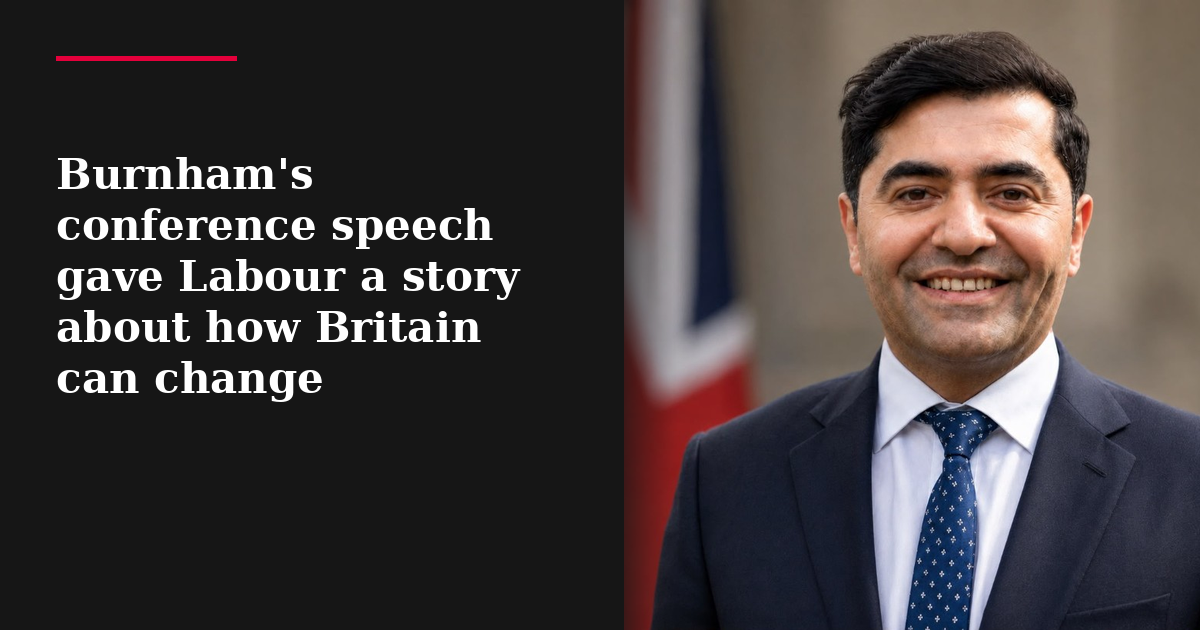
Cllr Ibrahim Dogus is Director of Labour Home and Chair of SME4Labour. He is a Labour councillor in the London Borough of Lambeth.