Families who lose loved ones to asbestos and other dust-related diseases are set to receive the same rate of government compensation as sufferers themselves, ending a long-standing disparity in the system.

The Department for Work and Pensions has announced changes to compensation rules covering occupational diseases including mesothelioma and pneumoconiosis, which can develop many years after workers were exposed to asbestos or harmful dust.
Under the existing system, dependants could receive substantially less compensation than the person suffering from the disease would have been entitled to claim. On average, sufferers receive £17,700, while dependants receive £10,700 — a shortfall of £7,000. Labour’s reforms will equalise those rates.
The DWP said:
“Dependants are set to receive the same compensation rate as sufferers, ending years of unfair discrepancy.”
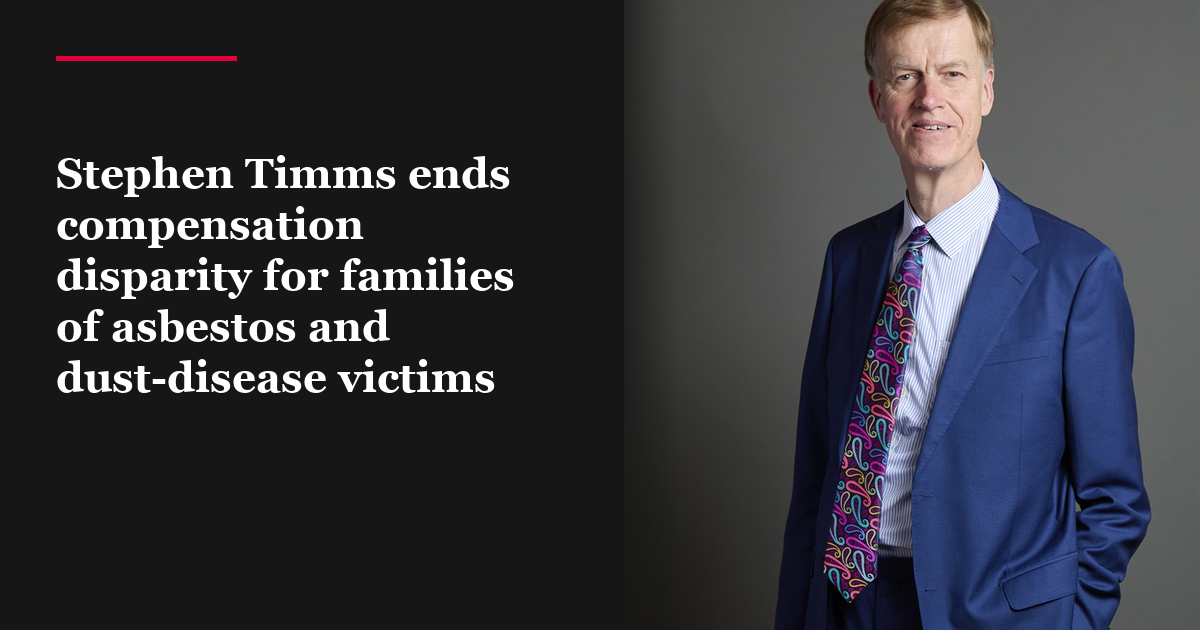
Sir Stephen Timms, the Minister for Social Security and Disability, said families who had lost a loved one to a disease caused by their work deserved support, “not a system that treats them as an afterthought”.
“That’s exactly what’s been happening, and campaigners have been telling us for over a decade that it’s wrong. Today we’re fixing it.”
Legislation implementing the changes was laid before Parliament on 1 September and, subject to parliamentary approval, is expected to come into force on 31 October 2026.
The Government is also simplifying the way compensation awards are calculated, replacing outdated arrangements with a clearer single award structure intended to make the system easier for bereaved families to navigate.
Workers who contract diseases such as mesothelioma or pneumoconiosis because of their employment can receive a one-off government payment where they have been unable to secure compensation from the employer responsible.
This can be particularly important with asbestos-related illnesses because symptoms may not emerge until decades after exposure, by which point the employer may no longer exist or its insurer may be impossible to trace.
In 2025, 2,730 sufferers received awards, while a further 300 payments were made to dependants at the lower rate. The Government estimates that equalising the payments will provide an additional £2 million to £6 million a year to bereaved families.
Campaigners, including the Asbestos Victims Support Group Forum UK, and parliamentarians have pushed for reform for more than a decade.
The changes are particularly significant for former industrial communities where generations of people worked in industries including construction, shipbuilding, manufacturing and heavy engineering and were exposed to asbestos and other dangerous materials.
Labour says the reforms are about restoring fairness for families who have already suffered the loss of a loved one as a result of occupational disease.
The move marks the end of a system in which the level of compensation could depend on whether the affected worker was still alive when the claim was made — ensuring bereaved families are no longer financially disadvantaged simply because their loved one died before receiving an award.