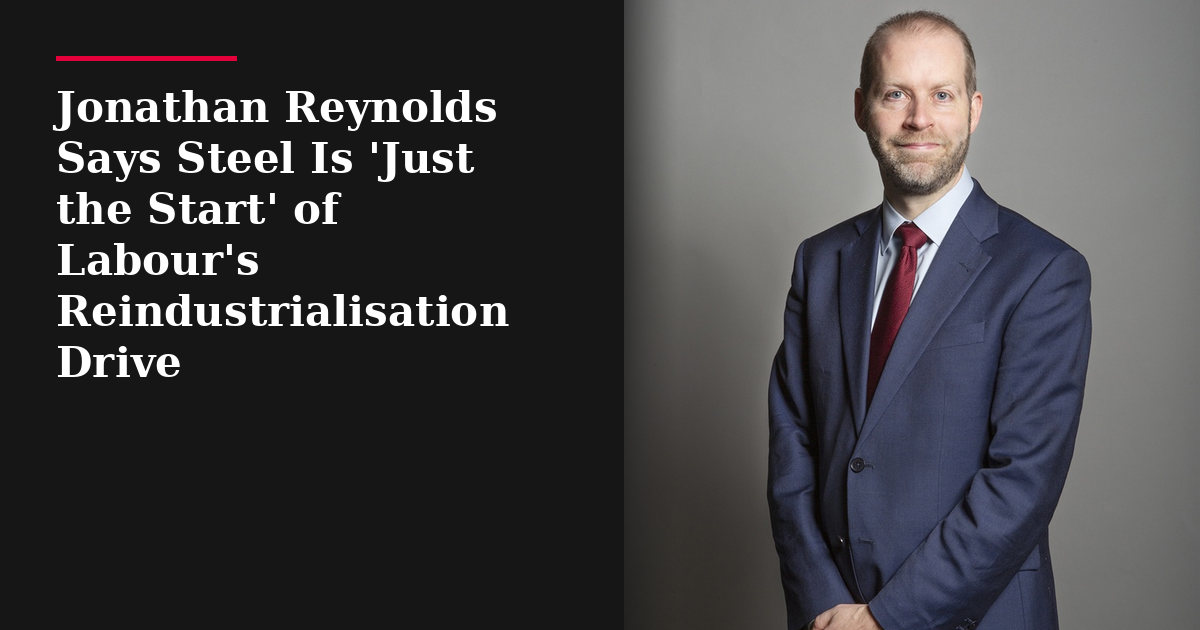
Business Secretary Jonathan Reynolds has said the Government’s intervention to protect Britain’s steel industry is only the beginning of a wider plan to reindustrialise the country, create skilled jobs and spread growth beyond London and the South East.

Writing in the Yorkshire Post, Reynolds argued that Britain had spent too long allowing industrial capacity to decline and said Labour was now determined to rebuild strategic sectors while attracting new investment.
He said:
“We made a commitment to reindustrialise Britain and bring good growth to every postcode.
“Steel is just the start.”
The Government has already taken British Steel into public ownership and is now working towards the public acquisition of Speciality Steel UK, whose sites in Rotherham, Stocksbridge, Brinsworth and Wednesbury support more than 1,300 jobs.
Protecting strategic steelmaking
Reynolds’ intervention comes after a series of major decisions aimed at safeguarding domestic steel production.
British Steel was brought into public ownership in July after ministers concluded that nationalisation was necessary to protect thousands of jobs, major supply chains and the country’s ability to produce strategically important steel. The Government said a strong domestic industry was essential to infrastructure, defence and national security.
Earlier this month, Reynolds also announced that the Government would work towards acquiring Speciality Steel UK after deciding a proposed private-sector sale did not provide sufficient long-term certainty or value for money.
The sites include production capabilities used in advanced manufacturing and have a long association with steel communities across South Yorkshire and the Midlands.
Tougher protection from cheap imports
The Government has also introduced stronger trade protections for domestic producers.
Since 1 July, tariff-free quotas on relevant steel imports have been cut by 51% compared with the previous safeguard regime, with imports above the quota facing a 50% tariff. Ministers say the measure is intended to protect British producers from persistent global overcapacity and unfair competition.
Government figures show UK crude steel production has fallen by more than half over the past decade, while international overcapacity continues to put pressure on producers.
Steel at heart of wider industrial strategy
For Reynolds, the steel interventions form part of a broader economic programme rather than a one-off rescue effort.
Labour’s industrial strategy is built around a 10-year approach intended to give businesses greater certainty to invest in high-growth and strategically important sectors.
Prime Minister Andy Burnham has also made reindustrialisation a central theme of his Government, arguing that Britain needs a more intentional approach to investment and stronger local industrial strategies so that growth reaches every part of the country.
Reynolds’ department is responsible for turning that agenda into policy across manufacturing, science, innovation and trade.
Jobs, skills and supply chains
The economic stakes are substantial.
British Steel alone supports thousands of workers directly and many more across its supply chain. Across the wider UK steel industry, government figures put employment at around 33,000 direct jobs, with a further 36,000 jobs supported in supply chains.
Reynolds has argued that retaining domestic steelmaking is therefore not simply about preserving individual plants, but about maintaining the industrial base needed for defence, construction, infrastructure, clean energy and advanced manufacturing.
The Government has also appointed Alan Lovell as chair of British Steel, with a brief to stabilise the business and help develop a commercially sustainable future.
Reindustrialising Britain
Reynolds’ message is that the Government wants to reverse decades in which Britain became increasingly dependent on overseas supply chains for strategically important goods.
Steel is being used as an early example of a more interventionist industrial policy — combining public ownership where necessary, trade protection, private investment and support for domestic production.
For Reynolds, the wider objective is to use that approach to rebuild Britain’s industrial strength, create skilled jobs and ensure that economic growth reaches communities that have too often been left behind.