An academic who transformed how we understand the connections between ancient monuments and the sky has been honoured by the University of Leicester.
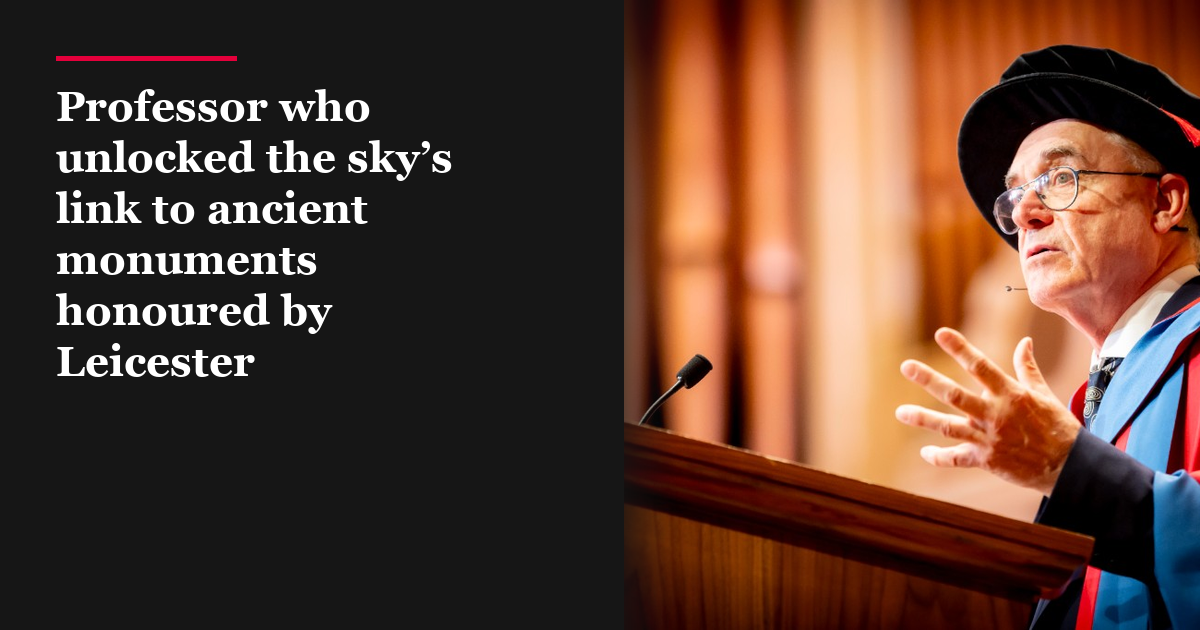
On Thursday 16 July, Professor Clive Ruggles received an honorary Doctorate of Science at a graduation ceremony at De Montfort Hall. Since becoming the world’s first Professor of Archaeoastronomy at Leicester in 1999, he has turned what was once seen as an esoteric pursuit into a serious academic discipline — the study of beliefs and practices relating to the sky in the past, and how that knowledge was used.
Professor Ruggles said: “Working in a highly interdisciplinary field, especially one that is new and developing, is challenging but can also be highly rewarding. For me, I have been spurred on throughout my career by knowing that what might seem an esoteric academic pursuit has real cultural value, whether it helps us better understand iconic ancient heritage such as Stonehenge, or supports living Indigenous traditions, such as modern Polynesians seeking to revive the skills of Pacific navigation.
“I am hugely grateful to the University of Leicester for supporting me throughout my often sinuous, and certainly unconventional, academic journey. When I set out on that journey over four decades ago I could never have imagined it would lead to an honour such as this.”
He arrived at Leicester in 1982 as a postdoctoral research assistant in the Department of Mathematics, applying statistical models to archaeological data. After lecturing in Computing Studies, he moved to the School of Archaeology and Ancient History in 1990, became Professor in 1999 and Emeritus in 2007.
Focusing first on Neolithic and Bronze Age Britain, his work combines anthropology with hard science to explain astronomical heritage sites — not least Stonehenge, the subject of his co-authored 2024 book Stonehenge: Sighting the Sun. In 2005 he identified the pre-Incan constructions at Chankillo in Peru as an astronomical site that allowed people 2,000 years ago to determine precise dates through solar observation. That research helped secure Chankillo’s inscription as a UNESCO World Heritage Site in 2021.
For more than two decades he has worked with UNESCO and its advisory bodies to recognise and protect outstanding cultural heritage relating to astronomy and pristine dark skies — work that helped pave the way for astronomical heritage sites, both ancient and modern, to be added to the World Heritage List since 2019, including Jodrell Bank Observatory.
He has served as President of the Prehistoric Society, the International Society for Archaeoastronomy and Astronomy in Culture, and the International Astronomical Union’s Commission for the History of Astronomy. In 2017 he became the first recipient of the Royal Astronomical Society’s Agnes Mary Clerke Medal for Historical Research. Other honours include the Association of American Publishers Professional/Scholarly Publishing Award, the Antiquity Prize and the Ben Cullen Prize.
In 2018, Prime Minister Theresa May bestowed the Points of Light Award on Professor Ruggles and Dr Sue Hills for their work with the Alice Ruggles Trust, a charity named after their late daughter that seeks to tackle stalking.
University of Leicester President and Vice-Chancellor Professor Nishan Canagarajah said: “Professor Ruggles has revolutionised both the academic interpretation, and public awareness of, ancient and historic monuments connected with the night sky, the Sun, and the Moon.
“His tireless research, inspiring leadership, and boundless collegiality have turned archaeoastronomy into a mainstream discipline through the anthropological understanding of cultures, which has had a huge impact on the identification, interpretation, and protection of astronomical heritage worldwide.”